Delivery Information
Although it is recommended to use the last current Incoterms, parties can agree to choose any version of the Incoterms rules. It is important, however, to clearly specify which version you have chosen.
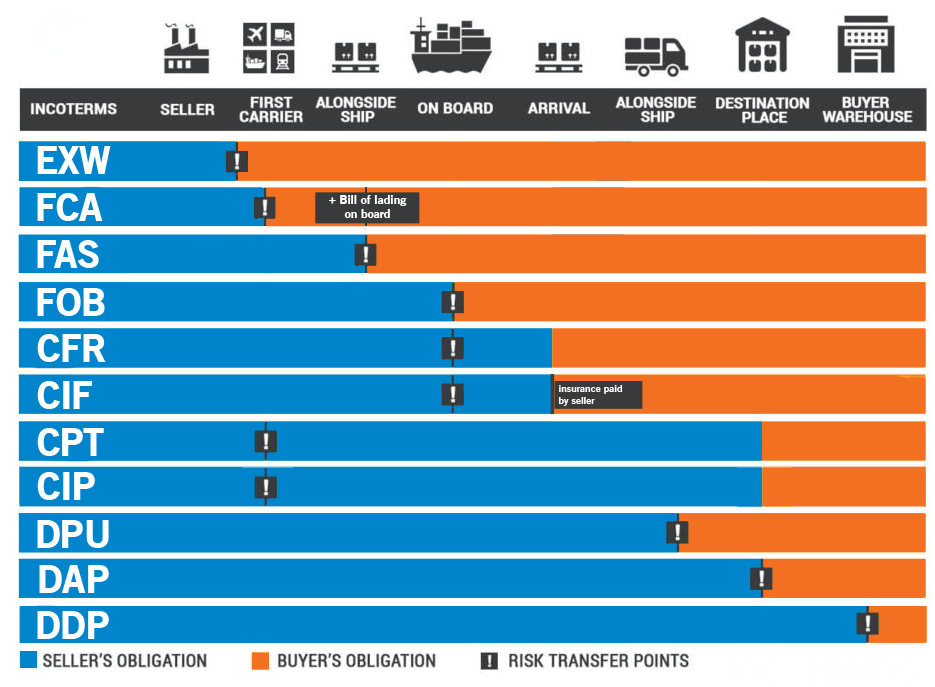
It is critically important during the tendering process, depending on the type of sourcing, whether strategic, tactical or project, that the terms of sales be discussed upfront and at every stage of the contract-formulation process.
More importantly, all stakeholders should be aware of both the advantages and the disadvantages of each Incoterm in order to be able make appropriate decisions when dealing with international trade transactions.
The following have to be noted before concluding and signing a contract (this is a requirement introduced by the Incoterms 2010 rules):
1. Specify your place of departure or port as precisely as possible:
If both parties agree on the use of a certain port or named place of departure, it is very important to name it as precisely as possible. This will avoid potential disputes as a result of ambiguity regarding the place.
This lack of specifying a place was probably one of the reasons why the experts responsible for the revision decided to incorporate this important point. For example, if both parties agree on FCA Incoterms, it would be advisable to state the arrangement as:
‘Unit 23 Rainbow Industrial Park, Gillette Avenue, Reading, UK as per Incoterms 2010.’
This is very specific and the seller will have a clear understanding that he or she will fulfill his or her obligation only once delivery has taken place to the stated address.
2. The specific Incoterm should be incorporated in the contract of sale:
Incoterms apply only if incorporated in the contract of sale or if they are, for example, mentioned in the offer, the sales conditions, the purchase order, the confirmation of an order or if they are stipulated by the parties in separate agreement.
With the new revised set of Incoterms and their requirements, it is important to note that whenever you want the Incoterms to apply to your contract, legal members who participate as a cross-functional team must make sure that they should make it clear in their contract through such words as:
‘The chosen Incoterms rule including named place or port followed by Incoterms® 2010’.
In addition to this, it must be stressed that when the parties intend to incorporate Incoterms into their contracts of sale, they should always make an expressed reference to the current version of these terms.
3. Appropriate Incoterms must be chosen:
Whenever Incoterms are chosen, it has to be stressed that they must be appropriate to the goods (type, weight, dimensions) that are going to be imported or delivered. In addition, the means of transport (road, rail, air or sea) also plays an influential role in the selection of the appropriate terms of sale.
Certain types of goods cannot be delivered by air because of their excessive weight. However, whichever Incoterm will have been chosen or agreed upon, both parties should always be aware that the interpretation of their contract may well be influenced by customs at a particular port or place being used.
It must be emphasised that all the personnel in a company responsible for concluding the contracts must be well-trained and have a full understanding of the different Incoterms and their implications, because choosing the wrong or an inappropriate Incoterm for a specific situation may be very costly.
4. Be aware that Incoterms rules do not give a complete contract of sale:
It is important to ensure that other contractual obligations are incorporated separately, for example payment terms, transfer of ownership of goods and also the consequences of a breach of contract that are normally dealt with in a service-level agreement (SLA).
If parties make the assumption that all other contractual aspects are covered by a chosen Incoterm, it will have seriously negative repercussions. Many disputes are as a result of the trading community not understanding the importance of creating a contract of sale that looks after the interest of both the seller and the buyer.
Ten common mistakes in using the incoterms rules
Below are some of the most common mistakes made by importers and exporters:
- Use of a traditional “sea and inland waterway only” rule such as FOB or CIF for containerised goods, instead of the “all transport modes” rule e.g. FCA or CIP. This exposes the exporter to unnecessary risks. A dramatic recent example was the Japanese tsunami in March 2011, which wrecked the Sendai container terminal. Many hundreds of consignments awaiting despatch were damaged. Exporters who were using the wrong rule found themselves responsible for losses that could have been avoided!
- Making assumptions about passing of title to the goods, based on the Incoterms rule in use. The Incoterms rules are silent on when title passes from seller to buyer; this needs to be defined separately in the sales contract
- Failure to specify the port/place with sufficient precision, e.g. “FCA Chicago”, which could refer to many places within a wide area
- Attempting to use DDP without thinking through whether the seller can undertake all the necessary formalities in the buyer’s country, e.g. paying GST or VAT
- Attempting to use EXW without thinking through the implications of the buyer being required to complete export procedures – in many countries it will be necessary for the exporter to communicate with the authorities in a number of different ways
- Use of CIP or CIF without checking whether the level of insurance in force matches the requirements of the commercial contract – these Incoterms rules only require a minimal level of cover, which may be inadequate.
- Where there is more than one carrier, failure to think through the implications of the risk transferring on taking in charge by the first carrier – from the buyer’s perspective, this may turn out to be a small haulage company in another country, so redress may be difficult in the event of loss or damage
- Failure to establish how terminal handling charges (THC) are going to be treated at the point of arrival. Carriers’ practices vary a good deal here. Some carriers absorb THC’s and include them in their freight charges; however others do not.
- Where payment is with a letter of credit or a documentary collection, failure to align the Incoterms rule with the security requirements or the requirements of the banks.
- When DAT or DAP is used with a “post-clearance” delivery point, failure to think through the liaison required between the carrier and the customs authorities – can lead to delays and extra costs


 Head Office & Repair Centre / İbrikdere Mah. 42. sok. No:13 CVO Building, KARTEPE / KOCAELI